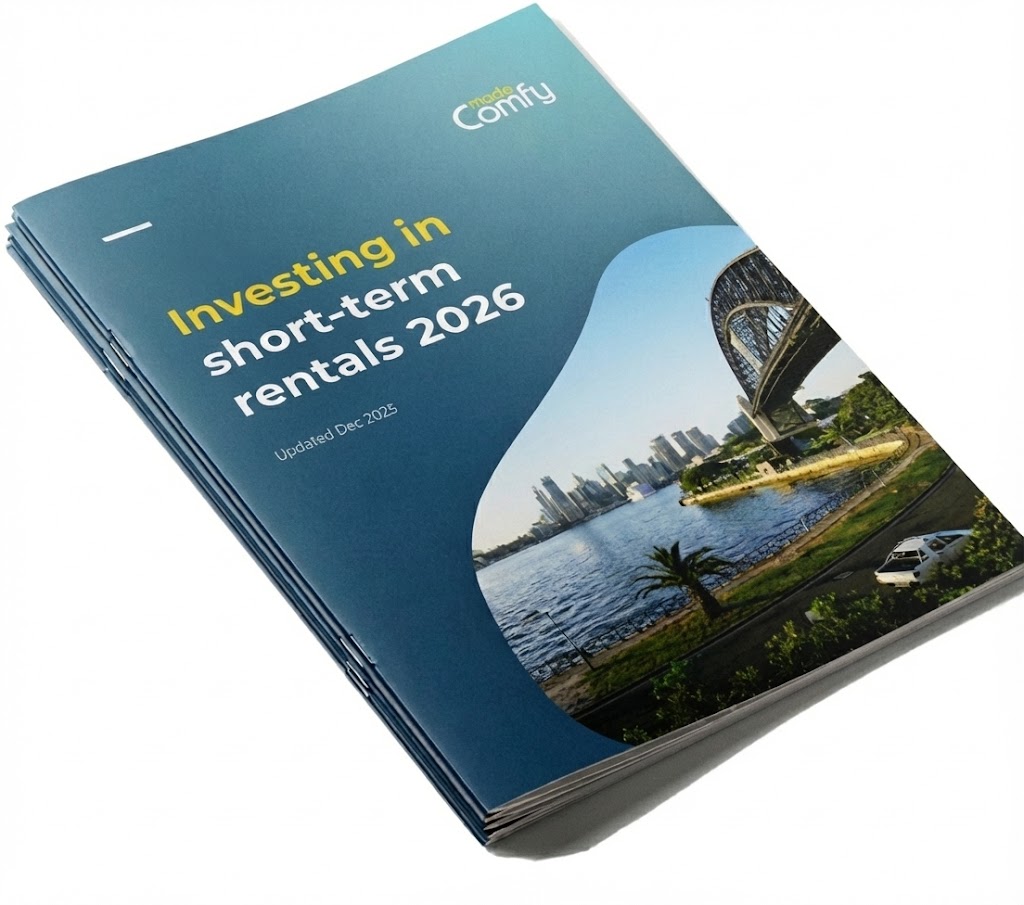
From Negative Gearing to Positive Cash Flow: Why Smart Investors Are Switching to Short-Term Rentals - 2026 budget update

The Budget has changed property investing. The next question is cash flow.
The 2026 Federal Budget has put property investing back at the centre of Australia’s housing debate.
For years, thousands of Australian investors have relied on a negative gearing strategy, tipping in extra cash to cover the mortgage while they wait for long-term capital growth. It worked when money was cheap and holding costs were manageable.
Today, with higher interest rates, tighter lending conditions, and rising expenses, that same strategy is under real pressure. What once felt like a clever tax play now feels more like you’re subsidising someone else’s lifestyle.
So the real question is this: can you turn your property into a cash flow positive asset without walking away from the tax benefits you’ve worked hard to unlock?
More investors are discovering they can - by shifting into short-term rental investment and partnering with MadeComfy to do it properly.
Understanding Negative Gearing
Understanding negative gearing
Negative gearing is simple: your property costs more to hold than it brings in, and you use that loss to reduce your taxable income. On paper, it’s a neat way to support a long-term capital growth play.
It’s popular because it can:
- Reduce your taxable income
- Help you hold higher-value assets for longer
- Support a “buy and hold” capital growth strategy
But there’s a catch: negative gearing only works if you can comfortably carry the cash loss.
In a rising rate environment, that’s getting harder. Mortgage repayments are up, rental yield in many parts of Australia hasn’t kept pace, and the tax refund rarely covers the monthly shortfall. At the end of the day, you’re still writing cheques to hold the asset.
That’s why more investors are reassessing whether their current property investment strategy in Australia is really working for them - or just for their bank and their tenant.'
Investor search trend section
Investors are actively searching for a better strategy right now
It’s not just you running the numbers again. Across Australia, investors are clearly back in research mode, looking for higher-yield alternatives that don’t blow up their risk profile.
Fresh commentary and market data this week point to renewed activity: more investors are scanning for better rental yield, stronger cash flow, and a smarter balance between negative gearing and positive gearing. Search interest around terms like property investing, rental yield Australia, and negative gearing vs positive gearing has jumped as people look for ways to protect their monthly cash position in a still-tight rental market.
On the ground, the story matches the data: rents remain elevated, vacancy rates are low, and more investors are testing short-term rental investment and Airbnb-style strategies to boost income, rather than relying solely on traditional negative gearing. The smarter money is looking for strategies that pay today, not just at some point in the future.
The Shift section
The shift: negative gearing vs positive gearing
There’s a clear shift underway from “I’ll wear the loss and claim it back at tax time” to “I want this property to pay for itself.”
Instead of depending on tax offsets and future capital gains, investors are asking a different question:
“What would it take for this property to actually pay me now?”
Short-term rental investment is one of the few levers that can materially change the income profile of the same asset. By converting a traditional long-term lease into an Airbnb investment property, many owners are increasing gross income substantially—without changing the property itself.
Why Short-Term Rental Returns…
Why short-term rental returns are changing the game
Short-term rental returns are built on nightly rates, not a fixed weekly figure. That flexibility is critical. It means your income can respond to real demand - peaks in tourism, local events, corporate travel, relocations - rather than being locked into a 6–12 month lease.
Done well, this can:
- Lift gross income above what a traditional lease can deliver
- Use dynamic pricing to capture upside during high-demand periods
- Give you more control over when and how the property is used
- Tap into premium guest segments that will pay more for quality
The outcome is what matters: in many cases, properties that have been firmly in the negatively geared camp can move toward neutral-or into cash flow positive territory - within months of switching to a properly managed short-term rental strategy.
Realistic Income Comparison
Right now your figures read oddly (you’ve got minus signs before income). Here’s a cleaned-up version that reads like an investor case study:
Realistic income comparison
Consider a typical Sydney investment apartment as an example.
Long-term rental (negatively geared):
- Weekly rent: $750
- Annual rental income: -$39,000
- Annual holding costs (mortgage, strata, insurance, basic maintenance): - $52,000
- Net cash position (before tax): - $13,000 per year
You might get some of that back at tax time - but you’re still out of pocket every month.
Short-term rental (managed by MadeComfy):
- Average nightly rate: - $220
- Occupancy rate: - 75%
- Annual booking income: - $60,000
- Management and operating costs (management fees, cleaning, linen, utilities, consumables): ~$20,000
- Net operating position (before mortgage): +$40,000 per year
On top of that, you may be able to claim tax depreciation benefits on furnishings, appliances and fit-out, as well as ongoing operating costs. Even after mortgage repayments, many investors find they move much closer to neutral or into positive cash flow - when the property is optimised as a short-term rental.
That’s the difference a higher-yield strategy can make to the same underlying asset.
Tax benefits section
You’re close here; I’d just make it more “this is how the numbers work for you”:
What about the tax benefits?
A common concern is that moving away from negative gearing means walking away from tax advantages. In practice, that’s not how it works.
With an Airbnb investment property, you can typically claim a broad range of expenses, including:
- Full-service management fees (like MadeComfy’s)
- Platform fees (Airbnb, Booking.com, and others)
- Cleaning, linen, and consumables
- Repairs and maintenance
- Utilities such as electricity, internet and water
- Furnishings and fit‑out costs
- Depreciation on furniture, appliances and potentially the building
These short-term rental tax benefits often mirror or exceed what you’d claim on a traditional lease. The key difference is you’re doing it alongside stronger income. You’re not giving up tax efficiency - you’re combining it with a more robust, income-focused strategy.
MadeComfy positioning - Why MadeComfy is the smart way to make the switch
Short-term rental isn’t a “list it on Airbnb and hope” play. The gap between average performance and top-tier returns is almost entirely execution.
MadeComfy acts as a specialist operating partner, running your property like a premium hospitality asset rather than a basic rental. That includes:
- High-converting listings with professional photography and investor-grade copywriting
- Dynamic pricing to capture demand spikes and protect occupancy in softer periods
- Distribution across multiple booking platforms, not just Airbnb
- End-to-end guest management, including 24/7 support
- Hotel-grade cleaning, linen and on-the-ground maintenance coordination
- Clear performance reporting so you can track your numbers like a business
The net result is higher occupancy, stronger yields, and a genuinely hands-off experience. You’re not buying yourself another job—you’re upgrading the way your asset is run.
Optimise your finance as well as your yield
If you’re serious about turning a negatively geared property into a cash flow positive property, your loan structure is just as important as your rental strategy. While MadeComfy focuses on maximising your short-term rental returns, our finance partner Shore Financial can review your loan, negotiate sharper rates, and help ensure your finance strategy actually supports your broader property investment strategy in Australia.
See what your property could really earn
If your property is currently negatively geared, it may not be underpriced - it may simply be underutilised.
See how much your property can earn with MadeComfy’s free appraisal tool and get an evidence-based view of its income potential as a short-term rental.
or
Book a free consultation with our team and map out a plan to transition your asset from a monthly cash drain to a genuinely cash-generating investment.

.png)